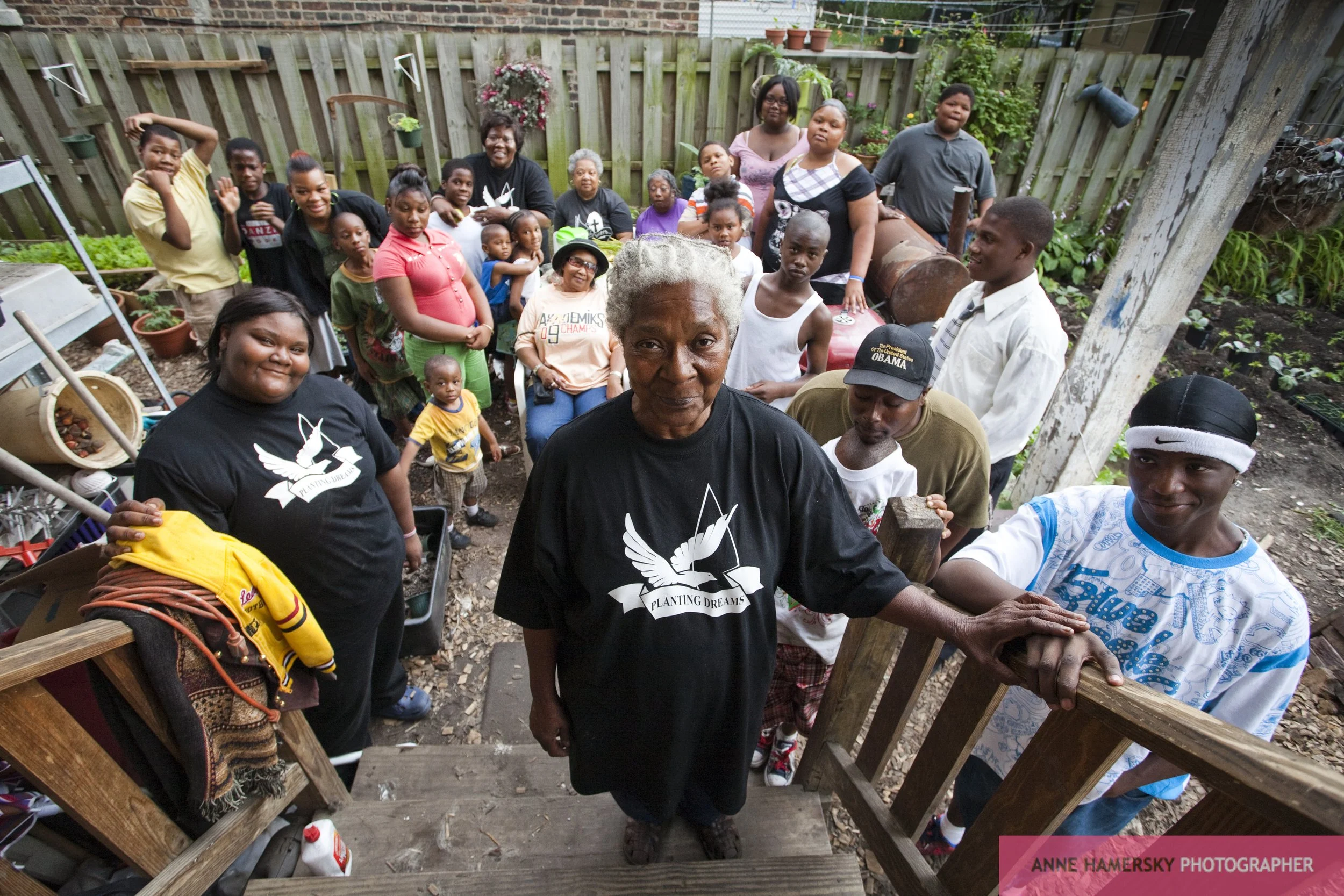
Who Needs Extended Family?
I grew up with a handful of first cousins that were all very close to my maternal grandmother, Carolyn Delores Thomas (“Lois” to her people). Most of us cousins actually lived at Granny’s house at some point in our lives. Her two-story, five bedroom, yellow brick house in Roseland on the Southside of Chicago was the center of our family’s universe. She raised her four children in this home. Her sisters, brothers, nieces and nephews spent many of their formative years there as well. ‘Immediate family’ to my mother’s generation included aunties and cousins, rather than just parents and siblings.
When I think about living primarily with my mom, sisters, and brother, I realize how much more isolated we were from our extended family than the generations before us. Rather than argue that one upbringing was better than the other, I’m interested in exploring what impact these different living arrangements have on our perception of who counts as family.
Let’s consider two definitions of family:
“any group of people closely related by blood or marriage, as parents, children, uncles, aunts, and cousins”
“a group of people who are generally not blood relations but who share common attitudes, interests, or goals and, frequently, live together.”
Though there are a number of other ways that family can be defined, these two definitions give us a solid premise to run with; families are formed by blood and/or common cause. If a connection by blood is ever in question, the accessibility of DNA kits in the 21st century make these unknowns fairly manageable. Differences in cultural values, life goals, and socio-political beliefs may make it more difficult to pin down who our chosen kinfolk will be. We might not live in the same house with those we share a common vision for life with.
The reality of genetic inheritance combined with the variable nature of one’s subjective philosophy of life, may present an interesting dilemma. What do I do when the family I’ve been born into doesn’t see the world how I see it? My own answer to this is multifaceted and takes into account what we learn from growing up spending time with whoever we consider to be our immediate family.
I trusted my Granny’s perspective of the world, but I depended on my Mom’s care and provision to survive childhood and adolescence. Having lived with both of them taught me that a woman can be a fierce leader, and simultaneously be vulnerable to the poison of an unwell partner. As a child I could not have articulated this, but I felt it. My Granny was the director of a youth outreach program called God’s Gang, which was founded at an A.M.E. church, to keep kids out of street gangs. My mom was one of her primary pupils and co-organizers of this mission. Relation and proximity made the rest of our family active agents of this mission as well. In 1996, when I was 11, we moved to Wisconsin, two hours away from God’s Gang and the immediate family that I knew. We inherited my stepfather’s relatives as well as a new church family through The House of God Church. This was a small holiness congregation composed mostly of families led by single mothers.
From 1997 to 2003 we spent most Wednesdays, Fridays, and Sundays at the House of God. One of my younger cousins told me recently that when she visited us back then she thought my mom was in a cult. I don’t include that anecdote to defame the church, as much as I’d like to use it to illustrate the contrast between our family’s more low-key A.M.E. experience compared to the dramatic shouting and tarrying that were key features of The House of God worship service. For all of its unique attributes, The House of God members effectively became our extended family, and for my siblings and myself this was not dissimilar to being born into a family that you did not choose.
My mother, however, was exercising her agency as an adult to choose her family. She loved the individual family members that she grew up with, her blood, but there were challenges in the family organization. My grandfather, Earl Thomas (Luin or Bird to his people), grappled with substance abuse and was no longer in the home with his wife and kids by the time my mom reached high school. She’s talked to me about the resentment that she felt towards her mother for her role in Grandad’s departure. The separation certainly impacted their family dynamic, and reverberated through the two generations that followed. By the time the ripples of their actions surfaced in my young adult life, and I was able to choose my family, I got married at 22. At 26, I moved 800 miles away from where I grew up and away from the family that I knew.
Now here I am, at 40 years old, reuniting, repairing, and trying to recreate some semblance of a new family. I remarried. I have three kids by marriage, and a 4 year old child that we made together; Indigo Lou Piña Thomas. We consider her to be the glue of some new Thomases, a catalyst for rebuilding and reconnecting. On Indigo’s second birthday in 2023, my DNA kit results popped up. I was an 18% match to a light-skinned black woman with an Irish last name, whom I had no clue how she could possibly be related to me. I contacted her. Within a day we came to the conclusion that she was likely my father’s half sister. Two years after connecting with my Aunt Jamie and many other amazing (distant) cousins, I’m convinced that we all need to seek the knowledge of the extended family we belong to in order to appreciate the winding paths and bold choices that brought us to where we are. The dots that connect us are living, breathing individuals with stories that illuminate the beautiful miracle of this complex existence.